
On this page
- Oregon City at a glance
- What makes gutter work in Oregon City different?
- What houses and roofs are typical in Oregon City?
- What is a sound gutter setup for Oregon City?
- How hard does it rain in Oregon City?
- What gutter work is common in Oregon City?
- When should Oregon City gutters be maintained?
- How should downspouts drain on sloped lots in Oregon City?
- Which roads, waters and landmarks are in or near Oregon City?
- How should homes near the bluff drain?
Oregon City at a glance
| Status | City and Clackamas County seat, incorporated 1844 |
| Population | 37,572 (2020) |
| Rivers | Willamette and Clackamas |
| Landmarks | Municipal Elevator, McLoughlin House |
| Roads | I-205, OR 43, OR 99E, OR 213 |
| Housing | 14,478 units, 64.9% owner-occupied |
What makes gutter work in Oregon City different?
History and the bluff. Oregon City, the county seat of Clackamas County, was incorporated in 1844, making it the first U.S. city west of the Rocky Mountains to be incorporated. It was founded near Willamette Falls in 1829 and was the last stop for settlers on the Oregon Trail. The Municipal Elevator, built in 1915 and now on the National Register, links the lower town to the upper town on the bluff, where the John McLoughlin House stands in the McLoughlin neighborhood.
For gutters, that means historic homes with original fascia and trim on the bluff, newer subdivisions to the south, and lots near the bluff edge where water needs a safe path.
Call
to be connected with an independent contractor who works in Oregon City.What houses and roofs are typical in Oregon City?
Oregon City had 14,478 housing units in 2020, up from 10,110 in 2000, with about 65% owner-occupied. Historic homes in the McLoughlin neighborhood and around downtown may have steep roofs, porches, decorative trim and half-round or built-in gutters. Newer neighborhoods to the south and east bring two-storey homes with valleys.
What is a sound gutter setup for Oregon City?
For most houses here, the setup below is a reasonable starting point. A contractor who measures your roof may change it. Call
to talk it through.| Item | Suggested for Oregon City |
|---|---|
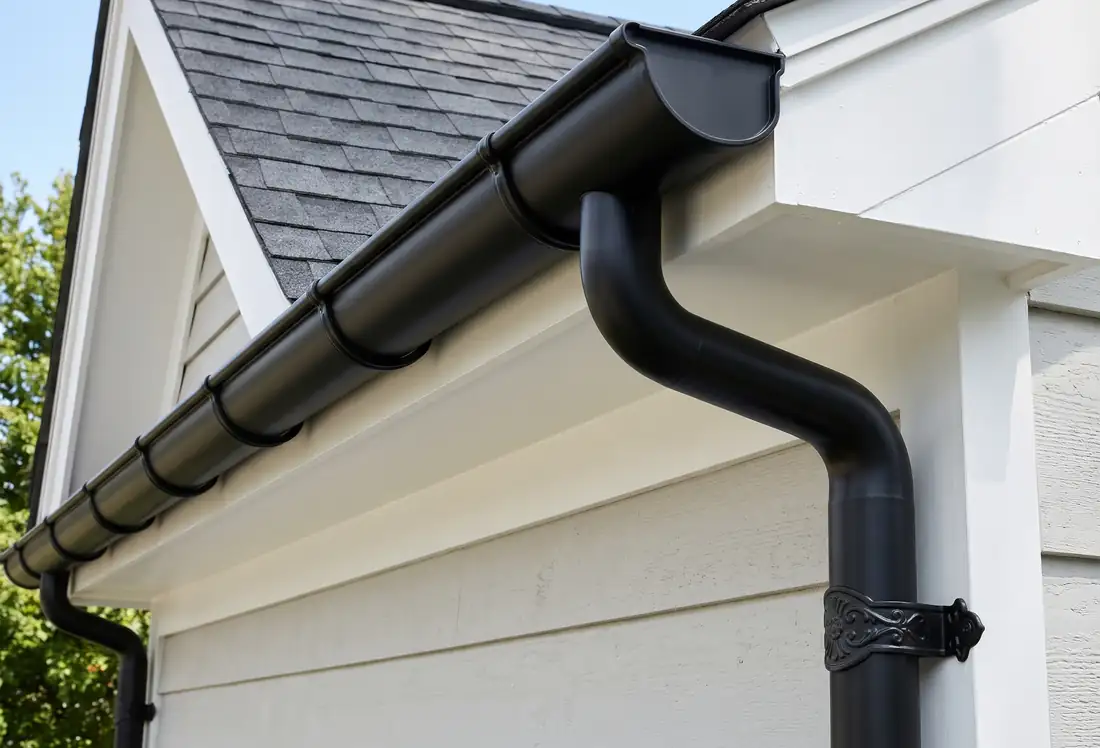
| Gutter | 5-inch K-style or half-round; 6-inch below valleys |
| Material | .032 aluminum; copper or half-round on historic homes |
| Downspouts | 3x4 or round |
| Hangers | Hidden hangers or brackets into sound wood |
| Guards | Micro-mesh where trees overhang |
| Cleaning | Late autumn and late spring |
| Discharge | To a safe outlet; not toward the bluff |
| Main risks | Old fascia, bluff-edge drainage, valleys |
How hard does it rain in Oregon City?
Steadily rather than violently. Portland's airport averages 36.92 inches of precipitation a year, with measurable rain on about 157 days and the most in December, November and January. The City of Portland's Stormwater Management Manual designs for a 10-year storm of 2.86 inches an hour over five minutes, and the figures below use that design storm; neighboring cities may use their own, but the regional climate is broadly similar.
| Gutter | Roof area one run can serve at 2.86 in/hr, 6/12 pitch |
|---|---|
| 5-inch K-style | about 1,755 sq ft |
| 6-inch K-style | about 2,530 sq ft |
| 5-inch half-round | about 795 sq ft |
| 6-inch half-round | about 1,220 sq ft |
These use the This Old House sizing method. In Oregon City, as across the metro, gutters usually fail because needles, seeds and moss block the outlets, not because the rain beats the gutter's capacity. Every inch of rain on 1,000 square feet of roof is still about 620 gallons, all of which has to leave through the downspouts.
What gutter work is common in Oregon City?
| House type | Usual problems | Usual work |
|---|---|---|
| Historic McLoughlin home | Rotted trim, half-round or box gutters | Fascia repair, half-round, relined box gutters |
| Bluff-edge lot | Drainage toward the slope | Route downspouts to a safe outlet |
| Newer two-storey | Valley overflow | 6-inch below valleys |
| Mid-century home | Thin aluminum | Seamless .032 replacement |
When should Oregon City gutters be maintained?
| Season | What to do |
|---|---|
| Late autumn | Main clean once leaves and needles are down; flush downspouts; check hangers |
| Winter | Watch outlets in long rains; check for bent runs after ice or wind |
| Late spring | Clear seeds, catkins and cones; brush loose moss from the lower roof |
| Late summer | Reseal corners and re-hang sags in dry weather, before the rains |
| After storms | Look for dents, pulled hangers, fallen limbs and crushed downspouts |
How should downspouts drain on sloped lots in Oregon City?
Oregon City is split between the lower town by the river and the upper town on a steep bluff. Portland's own guidance says not to disconnect downspouts on slopes greater than 10 percent, because concentrated water on a slope can saturate soil and run toward neighbors. On steep lots, carry downspout water to a safe, permitted outlet rather than onto the hillside, and ask your city before changing drainage. If a drain line needs digging, contact Oregon 811 at least two business days ahead.
Which roads, waters and landmarks are in or near Oregon City?
- Roads: Interstate 205, Oregon Routes 43, 99E and 213
- Water: Willamette River, Clackamas River, Willamette Falls
- Landmarks: Oregon City Municipal Elevator, John McLoughlin House, End of the Oregon Trail Interpretive Center
- Neighbours: West Linn across the Willamette, Gladstone across the Clackamas
How should homes near the bluff drain?
Away from the bluff edge. Concentrated downspout water on or near a steep slope can saturate soil and erode it. Route downspouts to an approved outlet and ask the City of Oregon City before changing drainage near steep ground.