
On this page
- Where do gutters leak?
- Why do joints fail in Portland?
- How should a leak be repaired?
- What about water dripping behind the gutter?
- When is replacing better than resealing?
- How can you spot leaks early?
- Which sealant should be used?
- What does a leak repair cost?
- Can leaks damage the foundation?
- Can a leak be fixed in winter?
Where do gutters leak?
At the joints. Call
and a contractor can find and fix the leak.| Leak point | Why it fails | Usual fix |
|---|---|---|
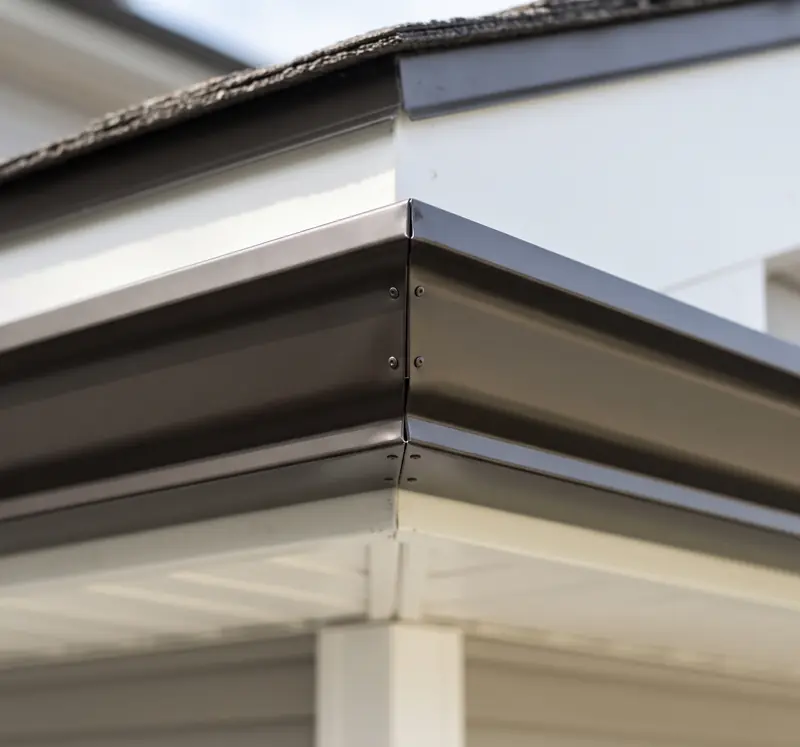
| Miter corners | Sealant ages; joint flexes under wet weight | Strip, clean, reseal, rivet |
| Sectional seams | Every seam relies on sealant | Reseal, or replace with seamless |
| End caps | Crimp loosens; sealant fails | Re-crimp, reseal |
| Outlets | Joint between gutter floor and drop | Reseal or replace the drop |
| Rust holes | Steel corroded by wet debris | Patch small holes; replace runs |
| Behind the gutter | Water runs between gutter and fascia | Fix drip edge, re-hang tighter |
Why do joints fail in Portland?
Because they stay wet for so long. Portland records measurable precipitation on about 157 days a year, concentrated from autumn to spring, and that is also when gutters hold needles, seeds and moss. Wet debris sitting against a joint keeps the sealant damp and dirty for weeks, while the gutter flexes under the extra weight. Over several seasons, the bond lets go. Steel gutters add a second problem: wet debris speeds corrosion along the trough.
How should a leak be repaired?
- Clear the gutter and flush the outlet.
- Remove old sealant completely from the joint.
- Clean to bare metal and let it dry.
- Re-rivet the joint where it relies on sealant alone.
- Apply gutter sealant inside the joint, tooled flat.
- Let it cure before the next rain if possible.
- Water-test the joint.
Because sealant needs dry metal, contractors often schedule leak repairs into dry spells. Late summer and early autumn are ideal before the wet season.
What about water dripping behind the gutter?
That is not a joint leak. It usually means the drip edge does not lap into the gutter, the gutter has pulled away from the fascia, or water is backing up behind a blocked outlet and spilling over the back. Left alone, it rots the fascia and can stain siding. A contractor may add or extend a drip edge, re-hang the gutter tighter to the fascia, and clear the outlet. See fascia and soffit repair.
When is replacing better than resealing?
| Situation | Better choice |
|---|---|
| One or two corners leak | Reseal |
| Leaks at most sectional seams | Replace with seamless |
| Rust holes along a steel run | Replace that run |
| Leaks return within a season | Look for a cause: weight, movement, backup |
| Old, thin gutters with many leaks | Replace |
See repair or replace.
How can you spot leaks early?
Walk around in a steady rain. Look for drips at corners and ends, streaks on siding below joints, dark patches on fascia, and splash marks or eroded soil under a joint. Photos help the contractor go straight to the problem.
Which sealant should be used?
One made for gutters, rated for outdoor movement and wet climates, applied to clean, dry metal. General household caulk is not a gutter sealant. On copper, joints are soldered instead.
What does a leak repair cost?
It depends on how many joints need work and how high they are. Resealing one corner on a single storey is a small job; several joints on a two-storey house cost more. Ask whether rivets, end cap re-crimping and a water test are included.
Can leaks damage the foundation?
Indirectly. A steady drip at a corner drops water in the same spot all winter, often right beside the foundation. Over time it can erode soil, splash siding and add water to a basement wall. Fixing the joint and making sure downspouts discharge far enough from the house protects both.
| Leak location | What it can damage |
|---|---|
| Corner above an entry | Steps, paths, door frames |
| Joint above a basement wall | Foundation, basement |
| End cap over a deck | Deck boards, ledger |
| Behind the gutter | Fascia, soffit, siding |
Can a leak be fixed in winter?
Temporarily, between storms, but sealant bonds best to clean, dry metal. A winter fix may need redoing in summer. For a lasting repair, schedule in a dry spell.