
On this page
- What goes wrong with downspouts?
- Why do Portland downspouts clog so often?
- What about downspouts that go into the ground?
- When can a downspout be disconnected?
- How should downspouts be fastened?
- What about rain barrels?
- Should you dig to fix an underground line?
- How do you clear a clogged downspout?
- How do you know if the underground line is the problem?
- When should a downspout be replaced instead of repaired?
What goes wrong with downspouts?
Call
and a contractor can clear, repair or replace downspouts.| Problem | Cause | Fix |
|---|---|---|
| Clogged elbow | Fir needles, maple seeds, moss | Flush; upsize to 3x4; add a guard |
| Crushed base | Mowers, cars, falling limbs | Replace section |
| Joints pulled apart | Loose straps, ice, wind | Re-strap; crimp and screw joints |
| Water spills at the top | Outlet blocked or too small | Clear; enlarge outlet |
| Water bubbles out at the ground | Underground line blocked or broken | Clear the line or disconnect |
| Erosion at the discharge | No splash block or extension | Add extension and splash block |
| Discharge against the house | Short or missing extension | Extend to a safe distance |
Why do Portland downspouts clog so often?
Because needles and seeds are small enough to enter the outlet but long or winged enough to jam at the first bend. Douglas fir, western red cedar and bigleaf maple are native to the region, and Norway maples are the city's most common street tree. A 2x3 downspout with two elbows close together is a common choke point. Upsizing to 3x4, straightening the route where possible, and fitting a guard that keeps debris out of the gutter all help.
What about downspouts that go into the ground?
Many older Portland homes have downspouts that drop into standpipes. Some connect to the combined sewer, which the city began building in the 1860s; others run to old drywells or the street. If water backs up out of the standpipe, the blockage is underground. Options include clearing the line, repairing it, or disconnecting the downspout.
When can a downspout be disconnected?
Under Portland's downspout disconnection guidance, when the extension can discharge:
| From | At least |
|---|---|
| A basement | 6 feet |
| A crawl space or slab | 2 feet |
| A neighbor's property line | 5 feet |
| Structures on an adjacent property | 10 feet |
| A public sidewalk | 3 feet |
| A retaining wall | Not within 10 feet |
The lot should not be steeper than 10 percent, and the landscaped area receiving water should be at least 10 percent of the roof area draining to it. No permit is needed for an extension and splash block. The standpipe left behind should be capped. See downspout disconnection in Portland.
How should downspouts be fastened?
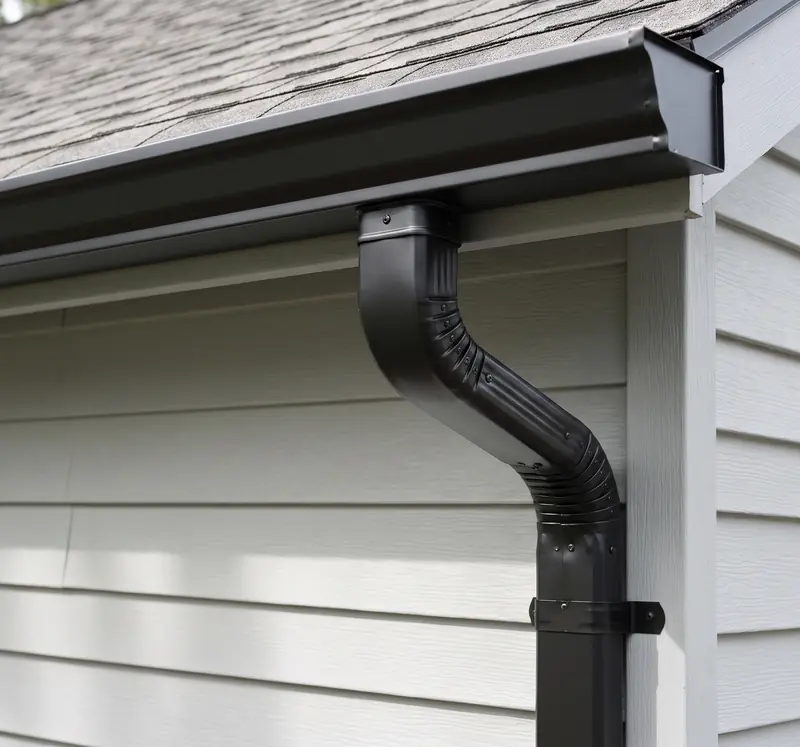
With straps at the top, middle and bottom, more on two-storey walls. Elbows should be crimped in the direction of flow and screwed, so they do not pull apart under ice or wind. The bottom elbow should feed an extension or splash block, not empty straight down beside the wall.
What about rain barrels?
A downspout can feed a barrel through a diverter, with an overflow that drains safely. Managing rain on your property in Portland may earn a Clean River Rewards discount on the stormwater portion of your bill, capped at 35 percent of total stormwater charges.
Should you dig to fix an underground line?
Call Oregon 811 at least two business days before digging. Utility lines can be shallow, even in small yards.
How do you clear a clogged downspout?
- Check the top outlet and clear debris from inside the gutter.
- Run a hose down the downspout from the top.
- Tap the elbows gently to loosen packed needles.
- Remove the bottom elbow and clear from below if needed.
- Refit and screw the elbow, crimped end pointing down.
- Test with water.
Stay off wet, mossy roofs, and leave two-storey downspouts to a contractor if you are not comfortable on a ladder.
How do you know if the underground line is the problem?
If the downspout runs freely when disconnected at the ground but backs up when connected, the line is blocked or broken. Signs include water bubbling out of the standpipe, soggy ground along the pipe route, or a sinkhole forming. A plumber can camera and clear the line, or a contractor can assess disconnection.
When should a downspout be replaced instead of repaired?
When it is crushed, split, badly dented or too small for the roof and trees above it. Replacing a single downspout is quick and inexpensive.